


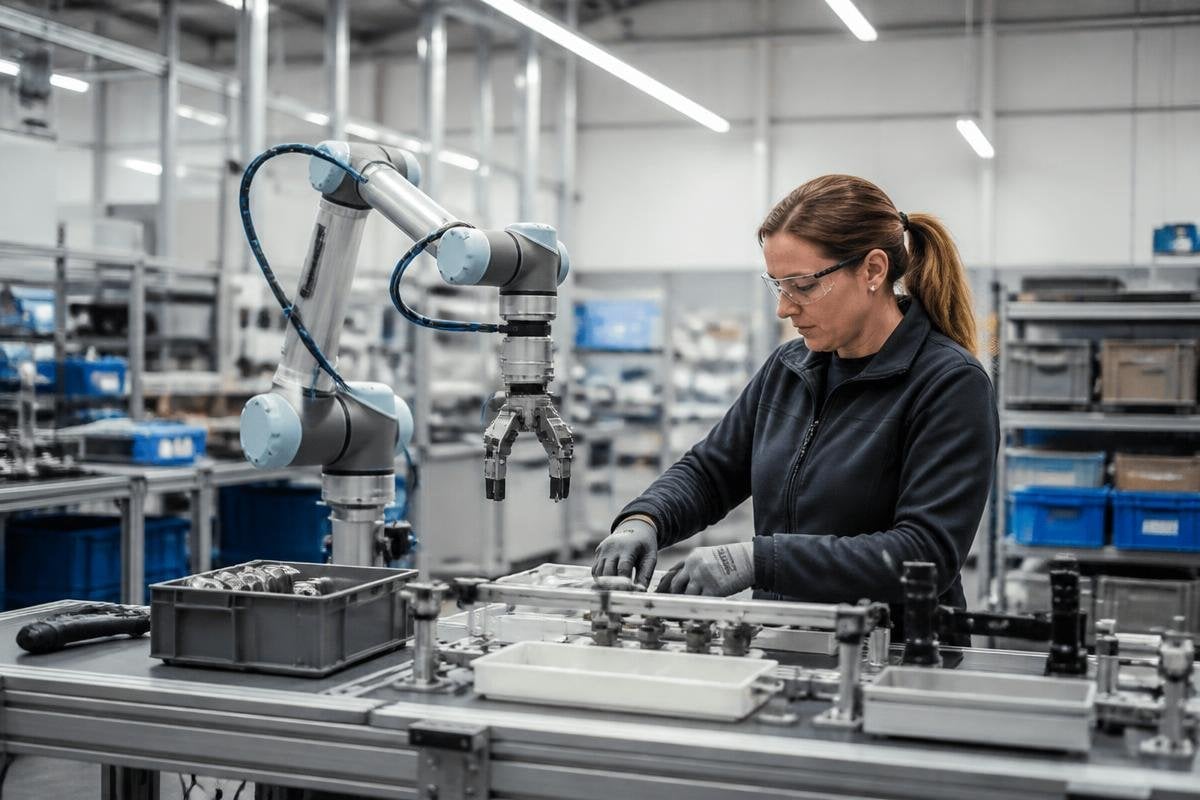
Work in a factory built around people and robots starts with the task, not the robot. The useful question is where a machine can carry load, repeat a motion, or watch a process while a person handles judgment and change.
- Give robots repeatable work with clear limits
- Keep people in control of exceptions and safety
- Design the space around handoffs, access, and maintenance
Start with the work
A robot works well when its job has a known start, a known finish, and objects it can find in a repeatable place. A person still has the advantage when parts arrive in mixed positions, the product changes often, or the right action depends on sight and touch.
That division can shape the factory layout. A robot arm may load a machine from one fixed position, while a technician checks the part, changes the fixture, or clears a jam. The value comes from the handoff between those jobs, not from giving the robot the whole process.
The handoff needs a physical design. A work cell needs space for a person to reach the robot’s controls, remove a part, and leave the area without crossing the robot’s moving path. It also needs a clear place for parts that fail inspection.
Make the robot easy to understand
People work beside machines more safely when the machine gives clear signs about what it is doing. A status light, a screen with plain fault text, and an easy-to-reach emergency stop can cut the time between a fault and a safe response.
Sensors shape that response too. LiDAR can detect objects around a mobile robot, while force sensing can show that a gripper has met an object or pushed too hard. These sensors help the control system react, but they don’t remove the need for a person to check the cause.
Software matters at the same level as hardware. A factory using ROS 2, a programmable logic controller, or a maker’s own control system needs a clear record of which system controls each motion. When an update changes that handoff, the team needs a test plan before production starts again.
Those handoffs need a record beyond the control cabinet. A factory manager can use reports at Robot24.com to check the named robot, task, work site, and date before changing a person’s role. That evidence helps the team decide where the robot takes over and where a worker must stay in control.
Put people where change happens
Factories change. A new part may need a different grip. A supplier may send boxes with a new shape. A quality check may add a step that the original cell never handled.
People should have a defined way to manage those changes. That can mean teaching a new robot motion, changing a fixture, adjusting a camera view, or stopping production until a safety check is complete. The process should name who can make each change and who must approve it.
Training should cover the real work around the robot. A technician needs to know how to restart the cell, read a fault, isolate energy, replace a tool, and return the system to production. A short video of normal operation won’t cover those tasks.
I’d design the cell around the person who clears the worst fault, not the person who watches the smoothest demo.
Measure the handoff
Teams can learn more from a failed handoff than from a long run of normal cycles. Track where the robot waits, where a person waits, how often a part needs help, and how long recovery takes.
Those measures show whether the robot is helping the work. A machine that completes its motion quickly can still slow the cell if people must walk around it for every part or wait for a reset after small errors.
The same check applies to maintenance. If a motor, camera, or gripper takes too long to reach, the factory has turned a small fault into lost production time. Access panels, cable paths, spare parts, and safe isolation points belong in the first layout review.
A practical design check
Before buying or moving a robot, check these points with the people who will run the cell:
- Name the task: write the start condition, end condition, part range, and handoff
- Mark the space: draw reach, walking paths, guarded areas, and service access
- Test the fault: record who stops the cell, who checks it, and how work resumes
- Check the data: list the sensors, controller, logs, and alerts the team needs
- Plan the change: set the approval steps for new parts, tools, software, and speed
- Price the support: include training, spare tools, maintenance time, and safety checks
The factory of the future will be built in these details. Robots can repeat a well-defined motion, while people handle changes that the original plan could not predict.
The next useful factory project will be the one that makes that division clear before the first robot moves.
